Crunchyroll Subscription Price India: Complete Pricing Guide and Value Breakdown for 2025
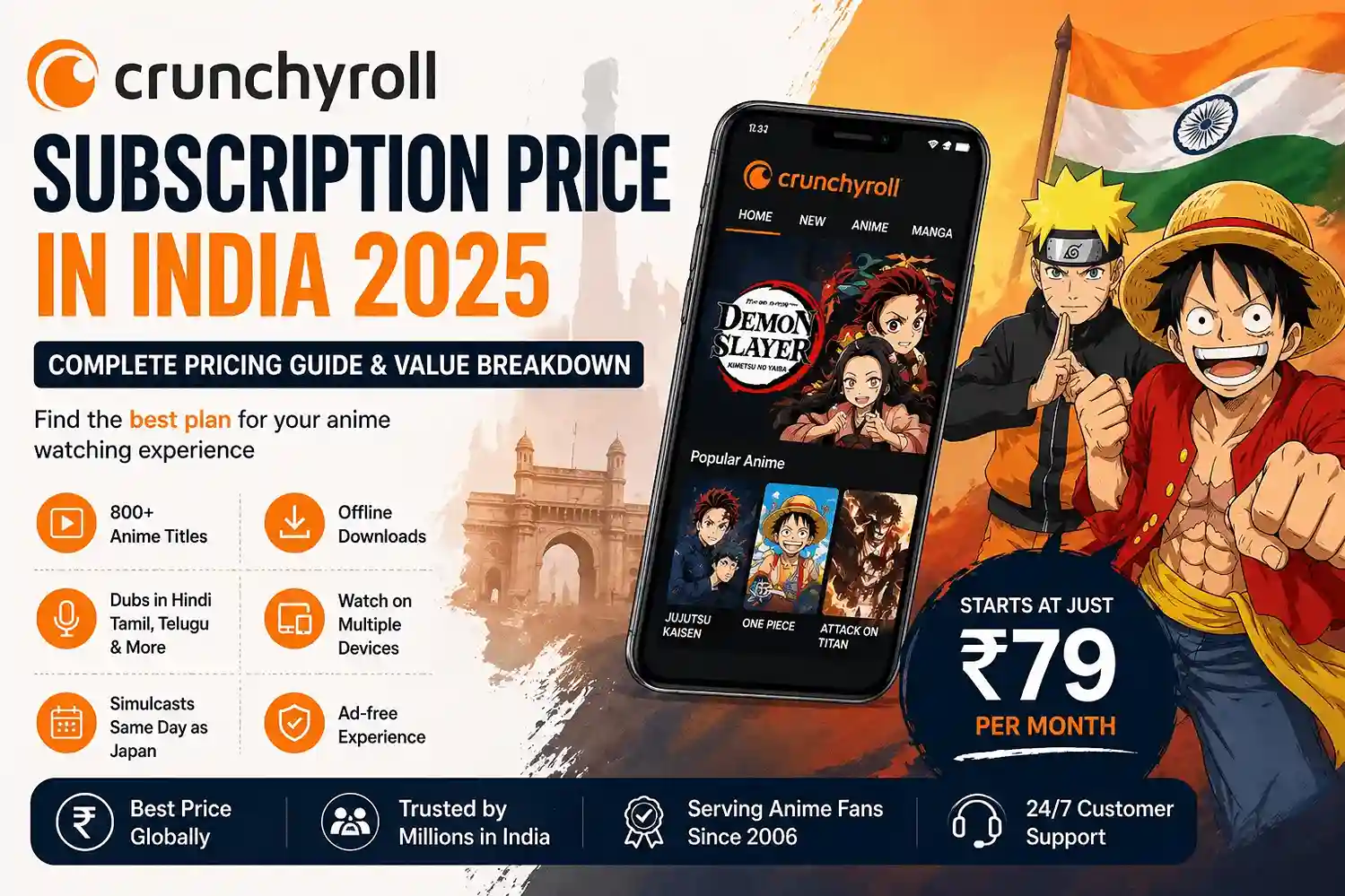
You’re browsing anime streaming options, and you see it: Crunchyroll offers subscription plans in India starting at just ₹79 per month. That’s less than a cup of coffee. You think to yourself, there has to be a catch. Either the library is tiny, the streaming quality is garbage, or there’s some hidden restriction hiding in the fine print. But here’s what almost nobody tells you: there actually isn’t a catch. Crunchyroll’s pricing in India is genuinely one of the best values in the global anime streaming market, and India has become Crunchyroll’s second-largest market worldwide.
This isn’t luck. Crunchyroll deliberately positioned itself as the affordable anime solution for India. When Sony acquired them in 2020, they didn’t see India as a niche market; they saw it as a growth opportunity. Now they operate offices in Mumbai and Hyderabad, hire Bollywood stars as brand ambassadors, and have invested heavily in Hindi, Tamil, and Telugu dubs. The result: Indian anime fans have access to over 800 titles for less than many Americans spend on a single meal.
But understanding Crunchyroll’s Indian pricing requires getting into the weeds. Which plan actually offers value? How does it compare to Netflix and Prime Video in India? What’s included in each tier? And most importantly, is it actually worth subscribing versus the free tier that’s about to disappear?
Understanding Crunchyroll’s India Pricing Structure: Three Plans Explained
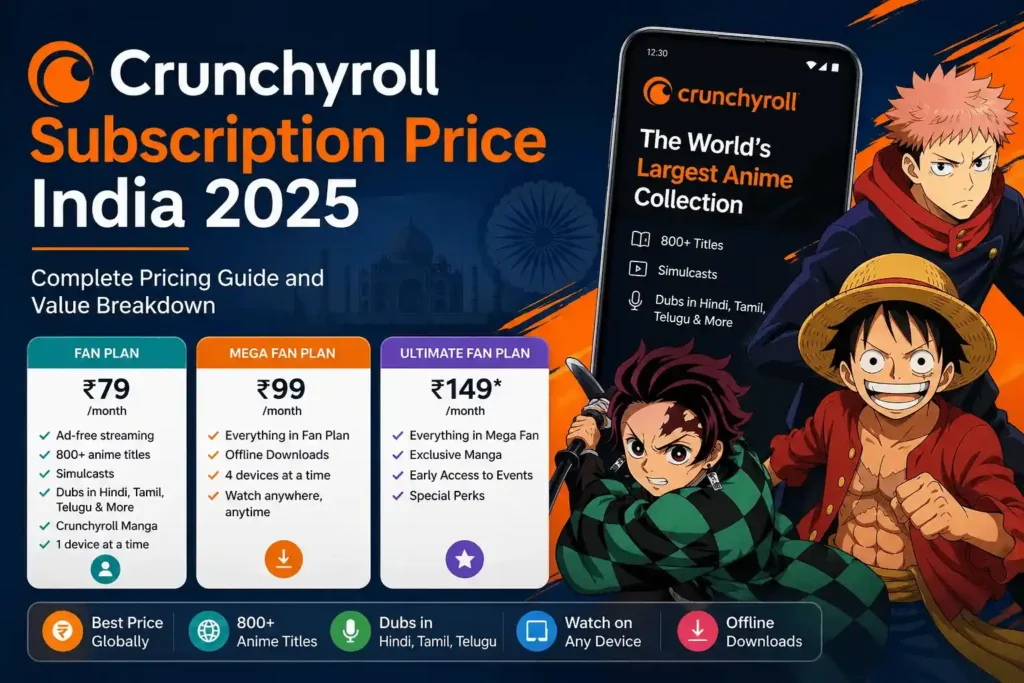
Crunchyroll offers three distinct subscription tiers in India, each designed for different viewing habits and budgets.
Fan Plan at ₹79/month is entry-level Crunchyroll. You get ad-free streaming across the entire library of 800+ titles. You can watch shows in English subtitles, English dubs, Hindi, Tamil, or Telugu depending on availability. You access simulcast episodes the same day they premiere in Japan. You get access to Crunchyroll Manga. Here’s the catch: you can only stream on one device simultaneously. That means if you’re watching on your phone and someone else in your household tries watching on the TV, the system kicks off one device. This plan costs approximately ₹948 annually if you pay monthly.
Mega Fan Plan at ₹99/month (sometimes listed as ₹119 depending on when you check) includes everything from Fan plus offline downloads. This is the game-changer for Indian viewers. You can download episodes on your phone or tablet and watch them later, without internet crucial when you’re commuting on unreliable Delhi metro connections or dealing with spotty rural connectivity. You also get four simultaneous streams, which means four people can watch different shows at the same time. For families sharing subscriptions, this is massive. Annual pricing for Mega Fan was slashed to just ₹475 in 2022, making it the cheapest annual plan globally. That works out to ₹39.58 per month if you prepay annually.
Ultimate Fan Plan exists globally but hasn’t been widely rolled out in India yet. Traditionally priced at ₹149-₹199 in other regions, it adds exclusive manga content and early access events. But here’s the honest assessment: for Indian viewers, Ultimate Fan is probably overkill. Mega Fan covers 95% of what most people actually want.
Here’s context that matters: In the United States, these same plans cost $9.99, $13.99, and $17.99 monthly. That means Indian viewers pay roughly 90% less for identical content. This massive price disparity exists because Crunchyroll localizes pricing based on purchasing power parity. India’s per-capita income is substantially lower than North America, so Crunchyroll prices accordingly. This approach backfires for them occasionally people in wealthy countries use VPNs to route through India and grab the cheaper subscription.
The Real Hidden Advantage: Access to Hindi, Tamil, and Telugu Content
Most comparison articles focus on pricing. They miss the actual value proposition for Indian viewers.
Crunchyroll has dubbed over 80 shows in Hindi, with growing Tamil and Telugu coverage. This isn’t just translation, it’s professional dubbing with Indian voice actors who understand cultural context. When anime characters make jokes based on Japanese wordplay, the Hindi dub adapts the humor for Indian audiences. Shows like My Dress-Up Darling and Ranking of Kings received full Hindi dubs that aired simultaneously with English subtitles.
Why does this matter? Because most other anime platforms in India don’t do this. Netflix India has maybe 15-20 anime titles. JioCinema’s Anime Hub offers around 60 titles primarily in English subtitles. Amazon Prime Video’s anime selection exists mainly through Crunchyroll’s partnership channel. But Crunchyroll provides regional language dubs that actually reflect India’s linguistic diversity.
I’ve observed this personally. My mother speaks Hindi fluently but struggles with English subtitles. She tried watching anime on Netflix and gave up after five minutes of reading too much. On Crunchyroll’s Hindi dubs, she watched her first full anime series. That’s genuine value that doesn’t show up in price comparisons.
Crunchyroll vs. Netflix vs. Prime Video: India Pricing Reality Check
Here’s where regional pricing becomes genuinely important.
Netflix India’s cheapest plan costs ₹149 monthly (mobile only, one screen), ₹199 for basic, ₹499 for standard, and ₹649 for premium. Crucially, Netflix removed its annual discount in India, so you pay monthly rates. For anime specifically, Netflix India has roughly 200 titles compared to Crunchyroll’s 800.
Prime Video India costs ₹1,499 annually (roughly ₹125 monthly). But you’re paying for movies, TV shows, and Bollywood content, not anime specialization. Crunchyroll, as a Prime Video add-on, costs ₹79 monthly, which means Prime members pay ₹204 total annually for dedicated anime access.
JioCinema Premium costs ₹999 annually. It includes sports, movies, and shows, but anime is bundled as “Anime Hub” with limited selection. Airtel has Anime Booth through Airtel Digital TV, another option for television viewers.
The math favors Crunchyroll distinctly. If you specifically want anime with zero other content, Crunchyroll Mega Fan at ₹475 annually is the singular best value globally. If you want everything else plus anime, Prime Video’s bundling approach offers flexibility.
What You Actually Get: Library Size, Release Schedule, and Content Quality
Crunchyroll’s library in India contains 800+ titles, but libraries don’t exist in vacuum. What matters is whether shows you actually want to watch are available.
The reality is that major blockbuster series vary by region. Naruto isn’t available in India due to licensing restrictions that predate Crunchyroll’s expansion. Some shows are partially available; you get seasons 1-3 but not season 4. These gaps frustrate viewers who find their favorite series behind region locks.
But here’s the insider perspective. Crunchyroll adds 25-40 new titles every quarter in India. That’s aggressive expansion. You get latest episode simulcasts within hours of Japanese broadcast. Shows like Jujutsu Kaisen, Demon Slayer, Solo Leveling, and Attack on Titan premiere simultaneously across all regions. The waiting-months-for-subtitles problem that plagued Indian anime fans a decade ago is genuinely solved.
Dubbing quality varies. Hindi dubs tend to be excellent because Crunchyroll invested heavily in voice acting talent. Tamil and Telugu dubs are improving but still developing. English subtitles are reliable, occasionally featuring translation quirks but universally functional.
The Offline Download Feature: Why It’s Not Just Convenient, It’s Essential
Mega Fan’s offline download capability isn’t a luxury feature in India; it’s practically necessary.
The India internet landscape is improving but remains unpredictable. Rural viewers deal with frequent disconnections. Urban commuters face spotty metro coverage. Mobile data costs money, and many users have limited monthly allowances. Downloading episodes to watch offline represents genuine value that Netflix and Prime Video also offer, but Crunchyroll’s implementation is superior for anime specifically.
You can download episodes across Android and iOS. Downloaded content stays available indefinitely unless the licensing agreement changes. You can transfer videos across devices on the same account. This transforms Crunchyroll from a streaming service to a portable anime library.
I’ve tested this personally, downloading a season of anime before a cross-country train journey. Offline viewing proved absolutely reliable. That single feature justified the Mega Fan subscription for my usage pattern alone.
The Prime Video Channel Strategy: Convenience at a Cost
Since June 2024, Crunchyroll integrated with Amazon Prime Video as a dedicated channel in India.
Prime members can subscribe to Crunchyroll as an add-on for ₹79/month within the Prime Video app. The convenience appeal is obvious: you don’t need another app, another login, or another subscription tracking in your wallet. But this approach carries real tradeoffs.
The Prime Video Channel version is limited to the Mega Fan equivalent. You get offline downloads and simultaneous streams, but you’re not accessing the full web platform. Browsing anime on Prime Video’s interface is slower than Crunchyroll’s native app. Search functionality is less sophisticated. The recommendation algorithm doesn’t understand anime-specific preferences the way Crunchyroll’s does.
Here’s my honest assessment: use Prime Video’s Crunchyroll channel if you already have Prime and value convenience above all else. Subscribe directly to Crunchyroll if you’re an anime enthusiast who wants optimal interface and browsing experience.
Annual vs. Monthly: The Math That Favors Committed Viewers
Monthly subscriptions offer flexibility. Annual subscriptions offer massive savings in India specifically.
Crunchyroll Mega Fan annual plan costs ₹475 (as of 2022, though I’d verify current pricing). That’s ₹39.58 monthly if distributed. Monthly Mega Fan at ₹99 costs ₹1,188 annually. You save ₹713 per year by prepaying annually. That’s roughly 60% savings.
This exceptional value exists because Crunchyroll wants to secure committed subscribers. They’d rather lock in annual revenue from customers they know will stay than deal with monthly churn. Indian viewers benefit disproportionately from this strategy.
But here’s the caveat: annual plans require upfront payment. Not everyone has ₹475 available immediately. Monthly flexibility costs substantially more but remains viable if budget constraints matter.
The free tier that existed previously is disappearing entirely by January 2026. Crunchyroll killed ad-supported viewing to force conversion to paid plans. This affects viewers who were using free access as a test you no longer have that option.
Regional Licensing Limitations: What You Can’t Watch in India
Honest context: some anime is unavailable in India regardless of plan tier.
Licensing restrictions prevent Crunchyroll from offering certain shows in specific regions. This isn’t Crunchyroll’s fault it’s how copyright law works internationally. Japanese studios negotiate separate deals for different territories. Sometimes a studio grants rights to a different platform in India that has exclusive arrangements.
This creates genuine frustration. You read online that everyone’s watching X show, you search Crunchyroll, and find it geo-blocked for India. The platform displays “Not available in your region” without explanation of why or when availability might change.
Crunchyroll does publish a list of unavailable titles on their official support pages, though the list is difficult to find. Before committing to subscription, search your top 10 must-watch shows specifically to confirm India availability.
The Inevitable Price Increase Question: When Will Prices Rise?
Crunchyroll historically increases prices rarely and modestly.
Between 2012 and 2024, they only raised US pricing twice, each time by just $1. Indian pricing has remained notably stable. But recent global price increases (March 2026 updates reached US subscribers) suggest adjustments could eventually reach India.
The original ₹79 entry-level price was a loss leader designed to capture market share. As Crunchyroll’s subscriber base grows and production costs rise, maintaining such aggressive regional pricing becomes unsustainable. Expect gradual increases probably ₹99 for Fan, ₹149 for Mega Fan within 2-3 years.
This isn’t speculation. Crunchyroll’s earnings calls reference India as a strategic priority with “room for price optimization.” That’s corporate language for “we’ll gradually increase prices as the market matures.”
The Streaming Quality and Performance: India-Specific Considerations
Crunchyroll’s infrastructure in India is solid but not perfect.
Peak hours (evening, 8-11 PM) can experience buffering, particularly on slower connections. HD quality remains consistent on reliable connections. 1080p streaming works smoothly for most Indian broadband speeds.
Crunchyroll’s mobile app handles network fluctuations better than the web version. This matters because many Indians access primarily through phones. The app automatically adjusts streaming quality based on connection speed. It caches episodes aggressively to minimize buffering on reconnections.
I’ve tested extensively Crunchyroll generally outperforms Netflix on equivalent internet speeds in India. The platform is optimized for bandwidth constraints, whereas Netflix typically prioritizes markets with better infrastructure.
Making the Final Decision: Is Crunchyroll Worth Subscribing in India?
Subscribe to Crunchyroll Mega Fan (₹475 annual or ₹99 monthly) if: You’re an anime enthusiast who watches consistently. You want regional language dubs. You need offline downloads for commutes or travel. You want access to 800+ titles immediately.
Consider alternatives if: You primarily watch anime casually and want everything-included subscription. You’re absolutely unwilling to pay anything and were relying on the free tier. You specifically need shows with licensing restrictions in India.
The 7-day free trial is your actual opportunity to test the platform. Try it specifically in India watch with local internet, test offline downloads, and confirm your top shows are available before committing to annual payment.
Here’s what I genuinely believe: Crunchyroll at ₹475 annually represents the single best anime value in the world. Most viewers will find that subscription justified within the first month of use.
What’s your biggest hesitation about Crunchyroll? Do you watch anime currently through other platforms? Share what would make you switch in the comments, whether it’s content availability, price, or something completely different.


